Blog

Theatre Games: Part 3

It’s been a while, but I’m back with part 3 of my series of articles on great theatre games. For this one, we’re focusing on teamwork and quick thinking skills. Drum roll…because it’s time to talk about… Location Creation!

Location Creation

This one could probably use a better name, but let’s go with it. I’ve heard it called the Martha Game, but honestly that name is worse than Location Creation. Who the heck is Martha? (If you know where the name comes from, let me know.)

How it works:

The entire group stands outside the acting area, ready to enter and be part of the game. The instructor gives them a location. Start with common locations, like a forest or a barnyard or a busy city street. Each student enters the scene one at a time and announces what part of the location they are creating. Then they adjust their body to approximate what they have announced. Speed is a necessity for this. The students shouldn’t spend time thinking about it – they need to just move into the scene and become something that fits with the location. By the end, your students will have created a complete scene using just their bodies. It is recommended that you only allow one ‘person’ to be in the scene – make them be objects as that will stretch those creativity muscles. Also, don’t allow multiple students to enter the scene at the same time – everyone needs to hear what the previous person chose to be because the most fun part of this is building off what the previous person did.

Example:

Let’s say the instructor gives the students the location of a beach. The first student runs into the space, saying I am the waves hitting the beach, and then approximates waves coming in and moving out from the shore. The second student says, I am a beach towel and lays flat on the ground. The third student says, I am a person sitting on the beach towel. A fourth student says, I am a person walking on the beach. The instructor says, Nope! Only one person per scene. Fourth student thinks quickly and says, I am the sunscreen the person is slathering over their arms. The fifth student says, I am a bird circling overhead. And so on. Each student continues to act out what they are until the final student enters the scene and completes the game.

The Why:

  1. It forces the students to think quickly, an important skill for actors of live theatre, as one never knows what happen on stage.
  2. It builds teamwork, particularly if you emphasize the idea of building on what the previous person did.
  3. It helps student focus on their bodies and how they can use them creatively to become an object that is not anything like themselves. Becoming a tree or ocean waves or the planet Saturn (all things my students have become at one time or another) is not easy and forces them to think outside of the box.

This game is a great way to get kids moving and working together quickly. I find it energizes them for the more difficult games. And you can get really creative with locations. I’ve done Outer Space, on the set of a TV show, and Inside your Body. I think Inside Your Body was actually the idea of one of the students. They came up with great stuff for that one – blood cells, the pancreas, digested food, etc.

Next up: What Are You Doing?

Ten Traits Kids Develop Doing Theatre

In my internet exploring, for which I did not use Internet Explorer, I came across a great article about the 10 traits parents should be helping develop in their children. As I read through them, I realized theatre education can play a crucial role in developing each one. Let’s take a look.

  1. Curiosity – Theatre demands kids develop their natural curiosity. So often this natural trait can be unintentionally sidelined by adults. We don’t always have time to answer every question a child asks, though we should probably work harder to find that time. Theatre education provides a great outlet for that for curiosity. We are constantly asking the why questions when creating characters and choosing how to respond in character to challenges.
  2. Social skills – Theatre is at its heart a team sport. Everyone has to work together to create a story. Kids have to get along and support one another to be successful.
  3. Resilience – Rejection is a big part of the theatre world unfortunately. Actors often audition for a part and don’t get cast. However, that reject builds resilience. A mom once told me that not casting her daughter in my play was the best thing that could have happened to her. She learned to keep fighting and not give up.
  4. Integrity – Theatre that isn’t honest isn’t worth doing. Theatre kids learn to recognize false words and false actions quickly because truth in acting is key.
  5. Resourcefulness – Live theatre is different than movies. There are no special effects (well, unless you’re in Harry Potter on Broadway), and we’re usually not performing in an actual house. But we still need to create the illusion of flying or complicated locations like the interior of a house. Resourcefulness is key to being able to create these experiences for the audience. Theatre kids also learn resourcefulness at a young age when they are asked to search their toy box for fake swords or perhaps a kazoo so they can play their part.
  6. Creativity – This one is a no-brainer, right? We know that theatre kids are creative. They’re creating stories, imagining what it’s like to be someone else, creating props and sets to tell the story.
  7. Empathy – This may be the most important skill taught by theatre. To be a successful actor, you need to be able to empathize with the character you’re playing. Kids have to understand the motivations of the other characters, too. Theatre teaches empathy, a crucial part of one’s humanity.
  8. Assertiveness – Theatre provides kids with the opportunity to practice being assertive in a safe environment. Playing Annie Oakley for instance offers the opportunity for an otherwise unassertive kid to pretend to be assertive. Any actor will tell you they take a little bit of every character they play with them.
  9. Humility – This kind of goes with the Resilience trait above – not only does rejection make you resilient, it also humbles you.
  10. Confidence – Along with Empathy, this may be the most important trait theatre teaches kids. Or perhaps I should say theatre provides a path for a kid’s natural confidence to emerge. Being onstage and part of a successful production is a confidence builder like no other. We hear all the time that one of the most common fears people have is getting up in front of a group of people. Theatre kids learn early to find that confidence within themselves to stand up and be noticed.

So parents, if you want a little help developing these important traits in your kids, sign them up for a theatre class!

Theatre Games: Part 2

Last time, I wrote about Three Pictures. This time we’re going to dive into one of my favorite improv games – Freeze and Justify. It’s one of my favorites, but it’s also one that so many people mess up. And mostly that’s because they forget about the second – and most important – part of the game. Repeat after me: You MUST justify!

Freeze and Justify

How it works:

Everyone stands in a circle. The playing area is the center of the circle. Yes, this improv game is theatre in the round. (Which makes me realize I should do a series about the different types of stages.) Two people are in the center of the circle and will create the first scene. The scene can be about literally anything, but here’s the key part. The person who starts the scene should choose an opening line that establishes two things:

  1. The relationship between the two characters.
  2. Where they are.

They continue the scene for a little while until one person (usually the teacher) yells “Freeze!” The goal of the person yelling freeze is to capture the actors in the most interesting physical positions possible. After they freeze, someone else from the circle taps the shoulder of the person who has been acting the longest and takes their place, assuming the exact same physical position of the person replaced. The newcomer starts a new scene that establishes a new location and a new relationship between the two characters, taking into account the the physical position they have copied. That’s the tricky part and the part that most people skip. You have to justify this (hopefully) goofy position you are starting the scene with.

Example:

Say two people are frozen and the one who has been there the longest is patting the ground with her hand. The newcomer comes in and says, “Sit right down here and let me show you how to fish like you have never fished before!”

Immediately, we know the location – near a body of water where fishing is possible – and the relationship – the expert fisherman and the novice. Plus, the actor used the physical position as part of the scene. Perfect!

The Why:

This exercise teaches students a number of important skills.

  1. It teaches actors to be conscious of their body and what story it could be telling. It’s important for actors to make specific choices in terms of body placement and actions to tell the story or illuminate the character they are portraying. This game forces actors to think about this in a very specific way.
  2. Like most improv games, it teaches teamwork. The actors have to work together to create an interesting scene.
  3. It teaches storytelling. By forcing the actors to create a relationship and a place with one opening line, it offers actors the opportunity to practice creating the beginnings of story. Who knows? One of these beginnings may lead to writing a whole play based just on the relationship between two characters and an interesting location.

This a fun game and theatre kids generally love it. However, it’s very easy to get away from the three most important tenets of the game – justifying the physical position and establishing a place and a relationship. Oftentimes they need to reminded and given the chance to start again. If you let it go and don’t enforce those tenets, you will get far less interesting scenes, the game will drag, and they’ll have a lot less fun. And they won’t learn as much.

Note that there are lots of variations of this game. This is my favorite version.

Next up: Location Creation

And sign up your kids (if you have any) for a theatre class!

Theatre Games: Part 1

Over the years, and with the help of the internet, I have created a repertoire of theatre games that I like to play with my casts and in my classes. To give some insight into my thinking as a theatre educator, I’m writing a series of articles about my favorite theatre games and more importantly, why I do them. It’s important for the students to understand the why behind the games, so they can be more thoughtful about their choices.

Three Pictures

How it works:

Divide the actors into groups of 3 to 4. You could have larger groups if necessary, but I’ve found that 3 to 4 works well. Explain to the groups that their job is to tell a story in three pictures using just themselves and maybe a chair or table if available. The pictures do not move – the actors must be totally still and they cannot speak. Give them 5 to 10 minutes to create their story. I usually walk around the room, giving feedback and reminding them their pictures cannot move (that’s the one element that seems hardest for them to grasp). Then each group shows each of the three pictures to the rest of the class. Each picture should advance the story and the audience should be able to describe what happened.

Example:

The easiest example and one I’ve seen done many times is the baseball player hitting a home run. The first picture shows the pitcher, the catcher and the batter all ready for the pitch. The second shows the pitcher having just thrown the ball and the batter swinging the bat. The third picture shows the catcher and the pitcher watching the ball fly and the hitter starting to run the bases.

The Why:

This exercise teaches students a number of important skills.

  1. They have to tell a story visually, no words, which emphasizes that theatre is very much a visual art form. Actions matter and we can communicate a lot with just our bodies and facial expressions even if we never speak a word.
  2. They have to work together to tell the story. Creating a play requires trust and teamwork.
  3. For aspiring playwrights, it demonstrates very clearly the need to have a beginning, a middle and an end to a story.

One of the elements of this game that I like a whole lot is the immediate feedback it provides. If the class doesn’t understand the story, that’s very obvious and tells the actors they need to work harder next time. I usually have them tell 3 or 4 stories with the same groups so they can practice the skills and improve.

Next up: Freeze and Justify

Theatre in Elementary School

teachappleI have long felt we need to teach theatre in our elementary schools the same way art and music are taught. There’s such value in it for all children. Theatre is something all kids understand immediately because they’ve been doing it since age 1. Every time your kid pretends to be a space explorer, that’s theatre. Every time your kid pretends to be a mommy to her baby dolls, that’s theatre. Every time your kid pretends to be a bubble creature with see through vision and the ability to walk on water… that’s theatre, too.
And then sadly oftentimes that imaginative play is lost somewhere around 6th grade. And often with it is lost confidence and self actualization, bravery and strength of character. Theatre can keep that confidence going. Theatre is power and we need to empower our children.

I have heard the argument that theatre shouldn’t be its own ‘special’ but rather incorporated into classroom as a teaching tool more than its own discipline. I agree that it should be used in teaching literature and probably other areas as well, but there is a skillset to theatre that is makes it an important discipline all on its own. Acting is a natural skill all children possess to a greater or lesser degree, but it can be honed and students can learn to improve it just as one can improve their music skills and their artistic skills. Not all students continue to study music or art into high school and similarly not all students will study theatre in high school. But just as all children benefit from art and music in elementary school, all will be enriched by intentional learning of this very important discipline: theatre.

A Deeper Dive into Kazoo

Auditions for Kazoo are just one week away! I thought I’d take some time to write down some thoughts about the script itself and why I made the choices I made in terms of the story.

What’s at the heart of the story? 

Kazoo is the story of Wren, a young teenage girl, who loses her only parent, her mother. In an instant, her life is upside down. She turns away from her friends, changes her look, and gets into trouble at school. The only part of her past that she holds onto is the kazoo her mother gave her. She plays it alone in her bedroom in her Aunt’s house, and while it helps a little bit, it’s not enough to erase the pain.

kazoo1That’s when magic enters the story. Wren’s kazoo disappears. A strange being gives her a magic kazoo that he says will help her find the one that is missing. Her friends show up to confront her about how she’s ignored them for months. And the three of them are thrown into a magic world.

What’s with the Dolphins, the Rabbits, the Snakes, etc?

Immediately Wren and her friends meet a group of dolphins, which turns out to be Wren’s favorite animal. This is the first clue that this magic world is being created by Wren and her friends. The dolphin scene is really about childhood, innocence, a last bit of joy before the three girls venture forth into the challenges that await them as they search for the kazoo.

Next, Wren and her friends meet the Rabbits. The Rabbits seem like a lot of fun, but soon the girls realize they’re in a state of denial about, well, everything. Wren finds this comforting because it allows her to forget about all that’s gone crazy in her life. She wants to live in denial, but in the end her friends pull her out.

After the Rabbits, they meet the Witch. Wren, realizing the Witch has magic powers, tries to bargain with her. She offers to stay if the Witch will bring her mother back. The Witch does, but with the help of her friends, Wren realizes the Witch has only brought back an image of her mother and she knows no bargain can be made.

Wren, frustrated and upset over the first two encounters, then meets the Python. The Python tells a story of a monkey who gives up on life and makes it sound like a happy choice to make. This is most dangerous moment of the journey so far as the Python represents depression, and Wren finds herself succumbing to the numbness that the Python offers. Only by connecting with her friends does Wren find the strength to escape the Python.

So that ending… with the flowers. Wren goes a little crazy there…

Finally Wren reaches a grove of flowers atop a hill. Here her missing kazoo is cradled lovingly in the arms of a flower not unlike the ones her mom and she visited when she was little. A vision of her younger self and her mom sends her over the edge, and her anger literally bursts forth from her, and in a fit of rage, she destroys the flowers and the kazoo she had been searching for.

That’s when her mom appears to her, to save her, and to repair the kazoo she was searching for. She brings the flowers back to life with the help of her friends. And she returns to her world with her kazoo having survived the journey.

Wren’s journey is one of grief, accepting it and moving on. That’s a pretty tough topic for kids, but I’ve included much humor along the way. And I believe strongly that kids need stories like this – ones that help them process the emotions coursing through them. Theatre allows for a safe space for actors and audience to experience emotions. We need to exercise our emotions just as much as we need to exercise our bodies and our minds.

So there’s humor in there too? 

Lots of humor throughout the script! Even when dealing with big emotional topics like grief, actors and audience can have a lot of fun along the way.

The Lawn Care Professional is a goofy character, one that I think a lot of people will enjoy. The Witch is sarcastic and self deprecating. And I think the Storytellers have a lot of humor potential in the way they interact with each other and the audience. The goal is to make a fun story that’s also emotionally impacting for the audience.

Why did you write this story? 

My work over the last few years has been all about empowering girls. I have three daughters, so it’s personal for me. I changed the genders of the older kids in my production of The Lion, the Witch, and the Wardrobe, so Susan got to kill the wolf and Peter had to experience the death of Aslan up close. In my retelling of the Guinevere and Arthur myth, I started with this idea: What if Guinevere and Arthur pulled the sword from the stone together? That lead to an empowering story for Guinevere and a more interesting one for Arthur as well. In Kazoo, I stayed a little closer to home, setting the story in modern times, perhaps making it even more accessible to our teen girls who dealing with difficult emotions every day. I wanted to provide a positive vision of girl friendship, where they help each other and even call each other out in a good way. Most of all, I wanted girls to know they’re not alone. Even if they don’t lose their mom, they are going to feel pain, emotions are going to seem overwhelming, and maybe they can help each other a little bit, by reaching out and listening to each other.

And mostly I just really liked Wren and I wanted to tell her story.

Kazoo, before auditions

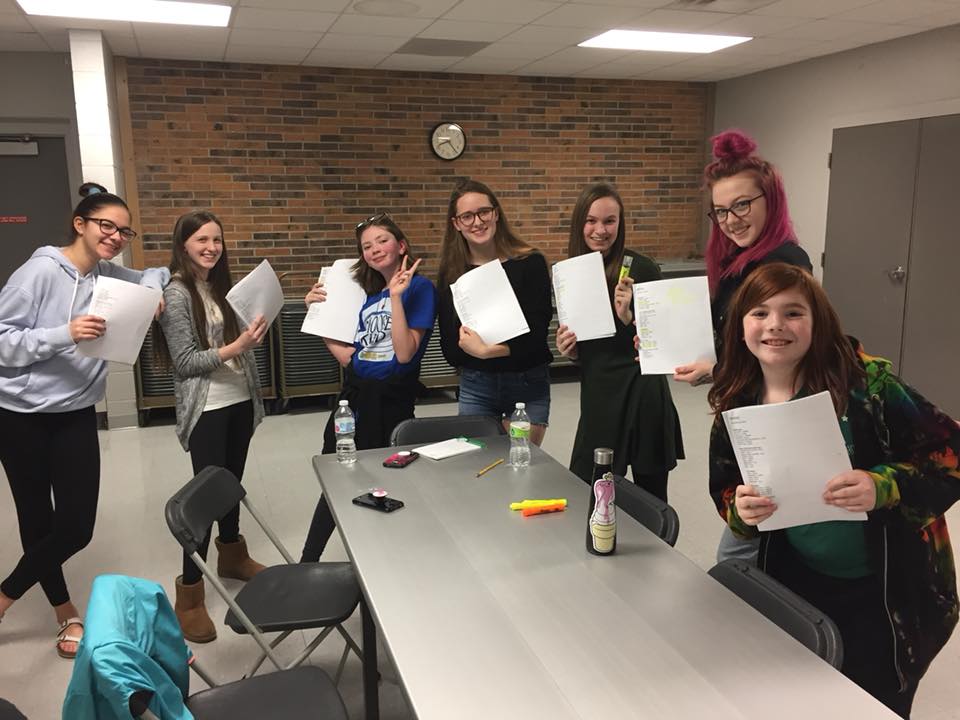
So very soon I will start a new theatrical journey. I suppose it started a while ago, with the writing, rewriting, public reading, more rewriting, and even more rewriting of my new play, Kazoo. Auditions are a few weeks away, the script is done except for a few language tweaks here and there, and I’m working with the producer to pull together a tech team. My costumer is already on board and we’ve been sharing costume ideas, which has been fun. Next week, I’ll meet with my stage manager.

kazoo reading
getting ready for a reading of the first draft

I’m excited about the show for a number of reasons.

Storytelling. This show has eight actors telling the story directly to the audience. They also become characters in the story as well. I like the idea of giving the kids the chance to learn storytelling techniques, which is different than creating a character. One of my goals when writing a children’s theatre play is to create challenges for the actors. I want them to have opportunities to learn. Of course, I also want the play to tell a good story, to be entertaining, and to have an emotional center that audiences can connect to. But always in children’s theatre, I want to focus on educating the next generation of actors.

Puppets! This play will have snake puppets that I’m really excited about. The main Python character will be 10-15 foot puppet, which will be manipulated by 3-4 actors. There will also be smaller snake puppets. One of the key aspects of plays is making things theatrical. There’s no point in doing a play if all you’re going to do is try to put a movie onstage. There has to be something inherently theatrical about the play for it to make sense to make it live theatre. Storytelling, my first reason for excitement, is inherently theatrical. And puppets fit with the theatricality of the show as well. And I love the idea of giving kids a rare opportunity to do something really different in the midst of the play.

piper snake
playing with the snake puppet

The story. I am telling the story of Wren, a young teenager who loses her mom and falls into a self destructive spiral, only to find her way out through her own strong will and with the help of two friends, Lily and Kaylee. Because it’s me, there’s magic involved and another world that they venture to. There’s a lot of challenging material for the lead actors, and I relish the opportunity to help them find their characters and harness the emotion necessary to pull it off.

The funny. The center of the story is how Wren deals with the loss of her mother, which is a tough topic. So of course, I put in as much humor as I could. I am hopeful I can let the actors loose to add some silly and fun to what’s already there in the script. I really love the Lawn Care Professional character and I want to see that character in particular shine with humor and fun.

And of course I’m also just thrilled to be working with such a great team at the Coralville Center for the Performing Arts and Young Footliters. And these kids! This is my fifth show in five years for Footliters and every year I get some familiar faces as well as a bunch of new faces. But whether they’re new or familiar, they always give 100% and are fun and funny and brave. I can’t wait for auditions!

Goodbye, Dreamwell

My final year as a part of Dreamwell Theatre, the company I founded along with my wife and two friends back in 1997, is over. What a fantastic 20 years it has been. I helped produce so many incredible shows, met so many good friends, and maybe made a few people think along the way. Not bad.

But I definitely need to exit stage left. My goal was always to create a theatre that lived beyond me. To that end, I promoted inclusivity from the start. The people making the decisions had to know that it was their theatre, too, and not just mine. That is my proudest achievement. To know that Dreamwell matters as much to so many other people as it does to me means we created something special and lasting. I want to see it grow without me. I know it will and I’m excited to watch it happen from the audience.

Sharon and I were awarded the first ever Founders Award for our dedication to the theatre at the Dreamwell Night of Stars, the annual awards celebration. It’s a sextant, which has been the symbol of Dreamwell, a theatre of exploration, for many years. To say it is my favorite gift ever is probably not much of an exaggeration.

As you might expect, I prepared a farewell speech. Sharon just spoke from her heart. You can watch the speech here:

If you want to skip all the thank yous and jump to my final message to the theatre, you can skip to 7:22 on the video. I sincerely hope that the board of Dreamwell takes my words to heart and seeks a new path forward. We must always be exploring, searching for new paths, and seeking new truths. I know the folks who remain behind will always put everything they have into Dreamwell. They always have and for that I am eternally grateful.

Here are my top eight Dreamwell show memories:

  1. Of Mice and Men – The show that really started it all. I played George, one of the more emotionally draining roles I’ve ever done. Sharon directed it. We had a lot of technical challenges, most notably when the door to the barn fell off its hinges because one of the actors could never remember to pull instead of push it open. The actor playing the boss memorably showed up on stage, grabbed the door and said “Quit breaking the place, you guys!” We had a long way to go, but even in that first show, the acting showed through. Neal Leaheey played Lennie and his was a heartbreaking performance.
  2. Someone Who’ll Watch Over Me – This story of three hostages in a foreign country was one of my tougher acting challenges. Fortunately I had an excellent director, Gerry Roe, and two fine actors, Matt Brewbaker and Thomas Williams, to work with. I had to perfect my Irish accent for the role, and I’m sure my ancestors appreciated my work in that area. My character is really the only one of the three who completely breaks down so once again, it was an emotionally draining, but incredibly rewarding role.
  3. That Day in September – I directed this one in 2007. It was written by Artie VanWhy who survived the 9/11 attack on the World Trade Center. Originally a one-man show, I transformed the script (with Artie’s blessing) into an ensemble piece for eight actors. Each played an archetype of our society. Still very proud of what we accomplished. I think it’s one that Dreamwell ought to bring back for the 20th anniversary of 9/11.
  4. All in a Day Play Festivals – These festivals (which we did with City Circle) are some of my favorite theatre events of all time. I usually write for them, though I did direct the first year. Forty or so theatre people created 6 or 7 ten minute plays in 24 hours. Such creativity and spontaneity. I won Best Play two years in a row for my writing. Dreamwell and City Circle has let this event slide the last couple of years, which is too bad. It’s so much fun.
  5. Soldier’s Daughter – Soldier’s Daughter was written mostly by me in collaboration with the Doggers playwriting group and performed promenade style at Janet Schlapkohl’s farm just outside of Iowa City. Promenade style means the audience moves from one location to another as the play progresses. I will never forget the scene where Eros is chased by Psyche down this long green hill. They begin as specks in the distance and then grow larger as they race down the hill. It’s an effect that could never be created on stage. Amy White’s Moose story was particularly memorable. Such a wonderful, unique and collaborative event.
  6. Fictional Murders – I directed this original play by Mike Moran, known as the Goatsinger. The reviewer was very kind: “Fictional Murders has a great plot, but the subject matter makes it difficult to portray without some innovative directing. This is where director Matt Falduto comes in. By placing the action on a traverse stage, so that two sets of audience chairs directly face each other with the action in the middle, Falduto creates a very intimate and very dynamic space to work in … The direction is done with care and the actors are very tuned in to each other; the effect is that we see the layers of fantasy and reality all onstage at the same time.” I am very proud of my work and appreciated how Dreamwell’s limited resources lead to more creativity in the direction of the show.
  7. Death of a Salesman – I played Biff, though I was too old and not much of a football player. In fact, I didn’t really even audition for it at first, but we didn’t get a great turnout, so the director, David Pierce, asked me to consider reading for it. I am so glad he did and so humbled that he trusted me with the role. I worked with incredible actors on this show – most notably Rip Russell and Krista Neumann as Willy and Linda Loman. If I never act again, and I may not, this was a great way to end my acting career.
  8. Antigone – I produced this one along with my good friend Chuck Dufano. Dreamwell took Mac Wellman’s version of Antigone and gave it to three directors to each create a half hour version of the show. The result was mesmerizing. Each version was totally unique and interesting – one was more comedic, one was more dramatic, and the last one was in your face confrontational. This is the sort of theatre Dreamwell needs to do more of as they plot a new course of exploration.

Dreamwell has done many great shows over the years – these are just some personal highlights for me.

Oftentimes people ask me – Where did the name Dreamwell come from? The story is simple. My very good friend, who I met when we were 11 or so, never says goodbye. He says dream well. And that sounded like a good name for a theatre company to me. Wishing someone good dreams is a beautiful sentiment, but to me it’s evolved into more than that – it means always searching for more, dreaming big, never giving up.

So what’s next? I will continue to work with Young Footliters, helping to train and inspire the next generation of actors. The truth is, those young actors inspire me all the time. I’ve loved the directing I’ve gotten to do the last few years and hope to continue to do it for many years to come.

I have written three plays for children now – Ozma of Oz, Guinevere and Arthur and Kazoo (premiering this fall at the Coralville Center for the Performing Arts). I’d like to see them all get a second production, so that will be a focus of mine as well.

Thanks to everyone who has ever supported Dreamwell Theatre over the years. May you all dream well.

2018

ATpicA new year. 2017 wasn’t the greatest year for me, though I suppose it could have been worse. The play I spent much of the year writing is stuck on my computer unlikely to ever see the light of day due to music rights issues. I learned a lot about that subject in 2017. It seems like everyone in my family had health issues last year – Sammi got a concussion, Piper’s hair fell out (though I guess that started in 2016), Sharon had a very serious eye infection… Rachel was okay though there were definitely non-health related challenges for her too. And of course, hanging like a dark cloud over everything was the fact that our government is lead by a criminal with no character, less smarts and no idea of what it means to be president.
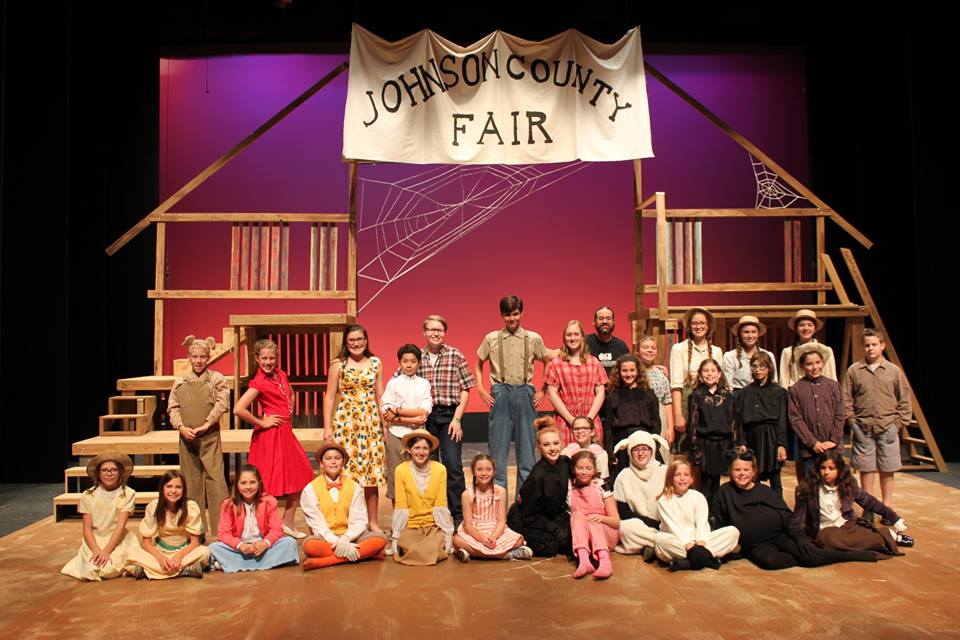
2017 did have some good moments, too. I became a member of the Dramatists Guild, another step on my journey toward publishing one or more of the plays I’ve written. I directed a wonderful production of Charlotte’s Web for Young Footliters. I did a couple of acting workshops that were very well received. And I’ve begun work on my next play which will be presented in the fall.

CW cast

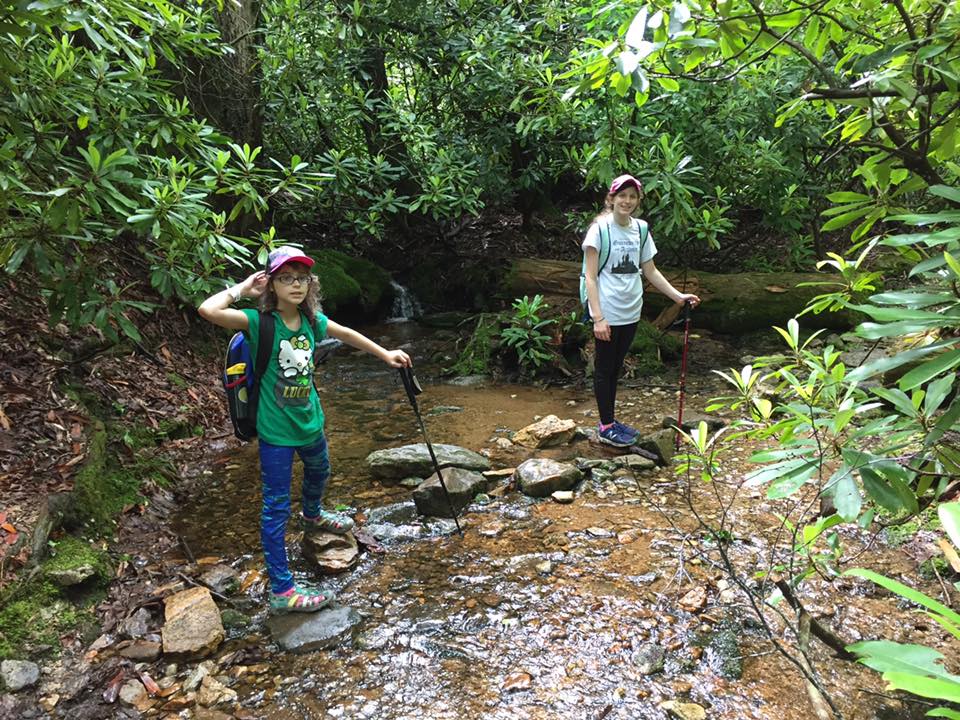
The rest of my family had a good year in a lot of ways too. Rachel excelled in high school, including Chemistry which she never imagined she would enjoy. Sammi is also doing really well in school, getting a 4.0. She also made a number of new friends, became a huge Sabrina Carpenter fan, and generally speaking really matured this past year. Piper explored some caves with Girl Scouts and continued to be the wacky fun kid we all love. I took Piper and Sammi on a camping trip and we hiked part of the Appalachian Trail, which was a lot of fun. Sharon took the girls to the Women’s March in Des Moines, which was an awesome experience. She also directed a play, wrote a lot, read many many books, and generally speaking was the glue that held us all together.

So some good, some bad… and a dark cloud hovering over all of us.

I don’t really do New Year Resolutions anymore. But I do have some goals for 2018. So I guess they are sort of resolutions.

  1. Finish writing and then direct my new play.
  2. Expand theatre education opportunities for kids in our area.
  3. Take more steps forward in getting one or more of my plays published.

All of those seem doable. Happy New Year! Here’s hoping 2018 is better than 2017!